In 1980, an 8-year-old found $5,800 of D.B. Cooper’s ransom on a Columbia River sand bar, but nearly 55 years after the hijacking, the case is still unsolvedAdrian Villellas Wed, November 25, 2026 at 11:07 AM UTC
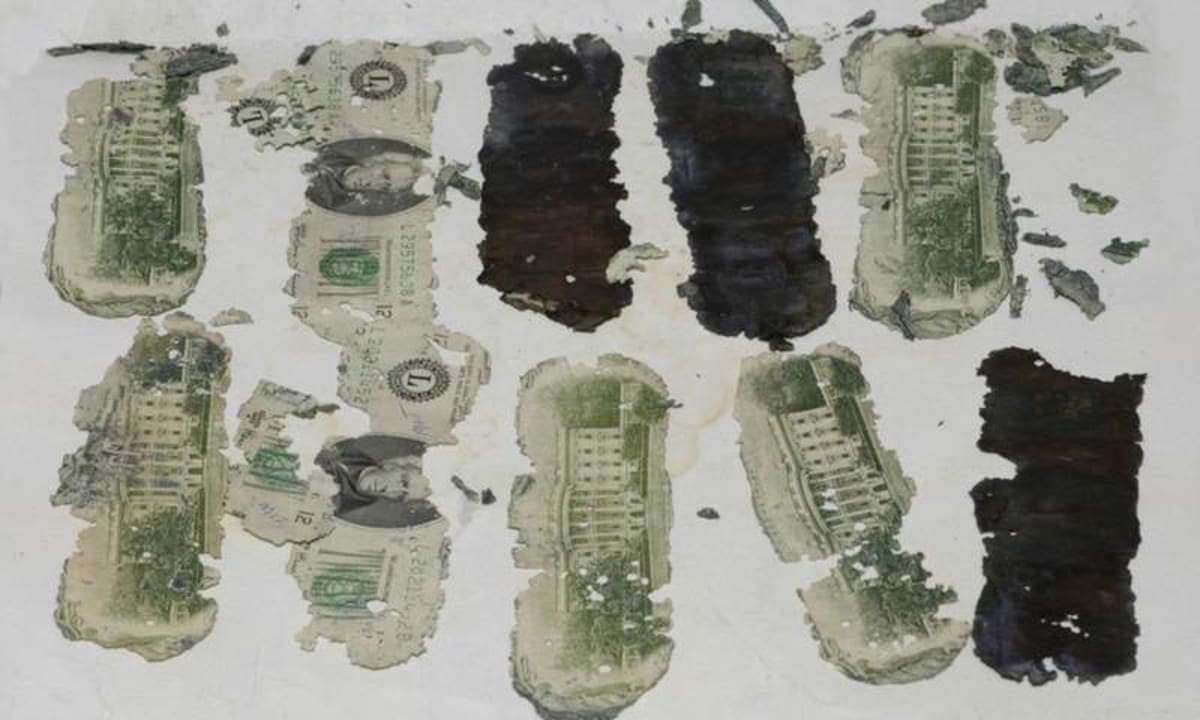
Some of the $20 bills from D.B. Cooper's ransom that a young boy found along the Columbia River in 1980. Credit: FBI
In 1980, an eight-year-old boy named Brian Ingram was on a sand bar along the Columbia River when he found a rotting package full of $20 bills. There was $5,800 in all.
The serial numbers matched money the FBI had been looking for since 1971: part of the $200,000 ransom paid to the hijacker known as D.B. Cooper. Cooper had parachuted from a plane into the night nine years earlier.
In 2009, the FBI called that money the only physical evidence in the case from after Cooper jumped. November 24, 2026, marks 55 years since the hijacking, and the man behind it remains, in the FBI’s words, a “still-unknown individual.”
A bourbon, a note and a briefcase
On the afternoon of November 24, 1971, the day before Thanksgiving, a quiet man who called himself Dan Cooper walked up to the Northwest Orient Airlines counter in Portland, Oregon. He paid cash for a one-way ticket on Flight 305 to Seattle.
He looked to be in his mid-40s and wore a business suit, a white shirt and a black tie. While the plane waited to take off, he ordered a bourbon and soda.
A little after 3 p.m., he handed a flight attendant a note saying he had a bomb in his briefcase. He opened the case just long enough to show her a mass of wires and red sticks. His demands were four parachutes and $200,000 in $20 bills.
In Seattle, Cooper let the 36 passengers go in exchange for the money and the parachutes. He kept several crew members on board and ordered the pilots to fly toward Mexico City.
The jump
Somewhere between Seattle and Reno, a little after 8 p.m., Cooper jumped out of the back of the plane with the ransom money. The pilots landed safely, but Cooper had disappeared into the night. His fate, the FBI says, “remains a mystery to this day.”
It was a cold November night with driving wind and rain, the FBI says, and he jumped somewhere between southern Washington and just north of Portland. Cloud cover at 5,000 feet meant there was no view of the ground.
Investigators first thought he was an experienced skydiver, perhaps a paratrooper, but later concluded he was not.
“No experienced parachutist would have jumped in the pitch-black night, in the rain, with a 200-mile-an-hour wind in his face, wearing loafers and a trench coat,” Larry Carr, the FBI’s Seattle case agent at the time, said in 2007.
Cooper had asked for four parachutes and jumped with two. One of them, a reserve chute, was meant for training and had been sewn shut, something an experienced skydiver would have checked, according to Carr. His parachute could not be steered, either.
Where the money turned up
All of this has led many FBI agents to doubt that Cooper survived the jump, though no one knows for sure. The bureau says the bills found in 1980 gave that theory “an added boost.” Only a small part of the $200,000 has ever surfaced, the FBI wrote in 2007.
The money also raised a question that is still open. Had the package been buried on that sand bar soon after the jump, or had it washed down the river over time?
In 2007, Carr suggested that science might help. “Maybe a hydrologist can use the latest technology to trace the $5,800 in ransom money found in 1980 to where Cooper landed upstream,” he said.
An FBI composite sketch of the hijacker who called himself Dan Cooper. Credit: FBI Click image to enlarge.A paleontologist joins the search
In 2009, the FBI described how a group of volunteers had taken up that challenge. It was led by Tom Kaye, a paleontologist who usually searched for dinosaur bones in the Wyoming desert, and included a scientific illustrator and a metallurgist. Brian Ingram helped them too.
The team ran soil, water and other experiments on the Columbia River and some of its tributaries. Using satellite maps and GPS, Kaye hoped to pinpoint exactly where Ingram had found the money.
One set of experiments, with a stack of bills on fishing line, was meant to help work out whether the money floated there over time or was buried there shortly after the jump.
Kaye also wanted to use an electron microscope to see whether pollen on Cooper’s tie came from a specific region of the country.
“After 37 years, we’re trying to use science to narrow all the possibilities,” he said. The bureau’s 2009 article described the work but did not report any conclusions.
Science has helped rule people out. Cooper took off his black J.C. Penney tie before he jumped, and in 2001 the FBI lifted a DNA sample from it.
That sample ruled out Duane Weber, a man who had claimed on his deathbed to be the hijacker. DNA tools have since helped investigators crack other cold cases.
More than 800 suspects
The FBI called the investigation NORJAK, for Northwest hijacking. Agents interviewed hundreds of people and tracked leads across the country. By the fifth anniversary of the hijacking, they had considered more than 800 suspects and eliminated all but about two dozen.
Even the name is uncertain. The “D.B.” was apparently a press mistake, the FBI says. Agents did question a man with those initials, but he was not the hijacker.
Carr thought the hijacker may have borrowed the name Dan Cooper from a French comic book series that was popular at the time. Its hero was a test pilot, and the cover of one episode published near the date of the hijacking showed him parachuting.
On July 8, 2016, after 45 years, the FBI redirected the resources assigned to the case to other priorities. The evidence is being preserved for historical purposes at FBI headquarters in Washington, D.C.
Who Cooper was, whether he survived and what happened to the rest of the money are still unknown. The money a child found on a Columbia River sand bar in 1980 remains the only trace of Cooper the FBI has described from after the jump.
The information was obtained from the FBI’s history page D.B. Cooper Hijacking, the FBI Seattle field office’s July 12, 2016, update on the investigation, and the FBI stories D.B. Cooper Redux (2007) and In Search of D.B. Cooper (2009).
—–
Like what you read? Subscribe to our newsletter for engaging articles, exclusive content, and the latest updates.
Check us out on EarthSnap, a free app brought to you by Eric Ralls and Earth.com.
—–
Source: Crime
